Understanding the Role of a Domain Registry in Modern Infrastructure

A domain registry serves as the authoritative database for a top-level domain (TLD), acting as the foundation for how websites are located and accessed across the internet. By managing the primary records for specific extensions, these entities ensure the stability, security, and global accessibility of the Domain Name System (DNS).

Quick Summary
A domain registry is the centralized administrative entity responsible for maintaining the master database of all domain names registered under a specific top-level domain. It defines policies, manages technical infrastructure, and ensures that domain resolutions remain consistent and accurate across the global internet ecosystem.
- The registry maintains the authoritative "zone file" for a TLD.
- It sets the operational policies for domain registration and renewal.
- It works with registrars to facilitate the sale and management of domain names.
- Registry operators ensure DNSSEC compliance to maintain network security.
Table of Contents
- The Mechanics of a Domain Registry
- Registry Services and the DNS Lifecycle
- The Relationship Between Registries and Registrars
- Ensuring Stability in a Modern Namespace
- Strategic Importance of Registry Operations
- FAQ
- Recommended Reads
The Mechanics of a Domain Registry
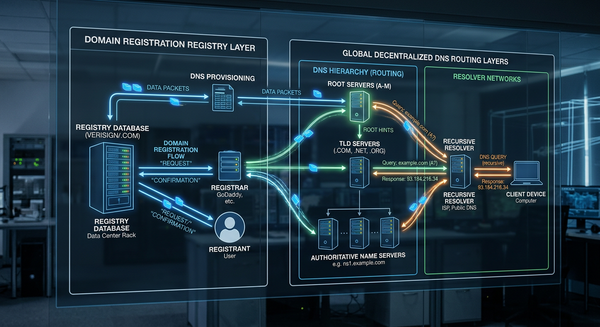
At its core, a domain registry is a highly specialized technical operation that maintains the authoritative registry of domain names. When an entity manages a registry, it essentially owns the "source of truth" for every domain suffix under its control. For example, if a company oversees a specific namespace, it is responsible for the technical infrastructure that allows browsers and mail servers to locate the correct destination for any domain ending in that extension.
The technical backbone of this operation involves running specialized servers that communicate with the root zone of the DNS registry system. This infrastructure must be resilient, as even a minor outage can render every website within that specific TLD unreachable. Consequently, registry operators invest heavily in geo-redundant data centers and high-availability systems to maintain constant uptime and data integrity for their assigned namespaces.
Registry Services and the DNS Lifecycle
Registry services encompass the entire lifecycle of a domain name. This begins with the initial registration and extends through the renewal, transfer, and eventual expiration of the asset. The registry is responsible for validating that requested names comply with local policies, such as character limits, prohibited terms, or specific registration requirements for country-code domains.
Beyond basic management, modern registry services include the implementation of advanced security protocols. Domain Name System Security Extensions (DNSSEC) are a primary component, providing cryptographic validation for DNS data. By signing the zone files, a registry ensures that users reaching a website are directed to the intended server, preventing "man-in-the-middle" attacks that could otherwise redirect traffic to malicious locations.
The Relationship Between Registries and Registrars
It is important to distinguish between the registry and the registrar, as their functions are distinct but complementary. While the registry manages the central database for a TLD, the registrar is the customer-facing entity that acts as an intermediary. When a user purchases a name domain com suffix, they are dealing with a registrar that interfaces with the registry's backend via an Extensible Provisioning Protocol (EPP).
This separation of concerns is a fundamental design principle of the internet's architecture. It allows for a competitive market where many registrars can offer services for the same registry's TLDs. The registry acts as the wholesaler of the namespace, setting the underlying pricing and usage policies, while the registrar handles the retail aspect, providing support, billing, and web management tools to the end user.
Ensuring Stability in a Modern Namespace
Maintaining a namespace requires constant vigilance regarding technical standards and policy enforcement. Registry operators must adhere to rigorous requirements set by global governing bodies, which include maintaining uptime Service Level Agreements (SLAs) and undergoing periodic audits of their operations. This ensures that the global internet remains a predictable and functional environment.
Pro Tip: When evaluating a TLD's reliability, consider the robustness of its Registry Service Provider (RSP). A top-tier RSP typically manages the heavy lifting of backend infrastructure, allowing the registry operator to focus on policy, marketing, and namespace distribution.
In addition to technical stability, registries are increasingly focused on "domain health." This involves monitoring the registry for high levels of phishing or malware distribution. By proactively managing who can register domains and how they are used, a registry can maintain the reputation and long-term value of its namespace, which is a critical consideration for investors and users alike.
Strategic Importance of Registry Operations
Registry operations represent the foundational layer of internet assets. Because they control the authoritative record of a domain, registries occupy a unique position in the digital economy, effectively managing a scarce resource that functions like digital real estate. For stakeholders, understanding the economics of these operations is key, as they generate value through registration fees and recurring renewal revenue.
Successful management requires a balance between aggressive growth and long-term sustainability. Operators must find ways to populate their namespaces with high-quality traffic and legitimate use cases. Those who treat a namespace as a long-term asset rather than a short-term marketing vehicle tend to see better stability in their renewal rates and overall ecosystem health. Building a diverse distribution network remains the most effective strategy for converting a raw namespace into a functional, revenue-generating asset.
FAQ
What is the primary difference between a registry and a registrar?
A registry owns and operates the database for a TLD, while a registrar acts as a retail partner that sells those domain names directly to the public.
What does an RSP do for a registry?
A Registry Service Provider provides the technical backend, servers, and security infrastructure required to keep the TLD online and responsive to global DNS queries.
How does a registry ensure DNS security?
Registries use DNSSEC to cryptographically sign their zone files, which authenticates that the information provided to the user is legitimate and has not been tampered with.
Can a registry also be a registrar?
While some entities may operate both, the industry standard often favors a separation of functions to ensure competitive neutrality and operational focus.