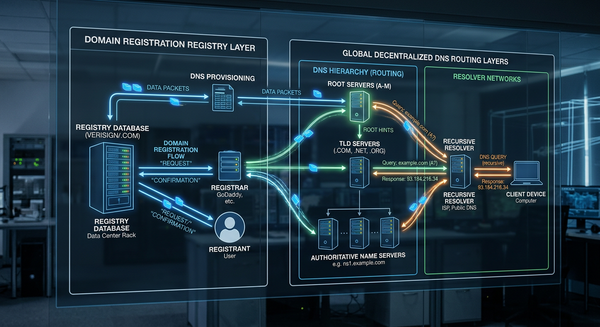
A Guide to Domain Name Registration US and International Namespace Requirements in 2026

Navigating the global landscape of internet addressing requires a nuanced understanding of regional registry policies. While the internet functions as a unified global network, the administration of specific top-level domains (TLDs) is fragmented, with each country or territory enforcing distinct eligibility criteria, local presence requirements, and technical standards. Whether you are managing a portfolio of assets or establishing a digital identity for a business, mastering these regional variations is essential for ensuring the longevity and security of your domain namespace.

Quick Summary
Domain name registration across international borders is governed by country-code top-level domain (ccTLD) policies that often require local nexus or physical presence. Success depends on aligning your registration strategy with the specific residency, legal, or trademark requirements mandated by the local registry of each jurisdiction.
- Understand local nexus requirements for ccTLDs.
- Verify residency or business incorporation criteria.
- Align registration timelines with regional administrative processes.
- Manage technical dependencies such as DNS and contact privacy.
Table of Contents
- Quick Summary
- Navigating Domain Name Registration US and Global Standards
- Regulatory Frameworks for UK Domain Name Registration
- Compliance in Domain Name Registration AU {#domain-name-registration-au}
- Protocols for NZ Domain Name Registration and Domain Registration NZ
- Navigating Domain Registration Netherlands
- Common Pitfalls and Troubleshooting
- FAQ
- Recommended Reads
Navigating Domain Name Registration US and Global Standards
Domain name registration US markets generally follow an open policy structure, primarily utilizing gTLDs (generic top-level domains) like .com, .net, or .org. These domains are typically unrestricted, meaning any individual or business, regardless of geographic location, can register them provided they adhere to the terms of service set by the registrar. The focus here is on contractual obligations and the accuracy of Whois data, which must remain updated to comply with current ICANN-mandated standards for domain management.
When operating in the US, the primary challenge is not eligibility but rather security and portfolio management. Registrants must ensure that domain contact information is shielded where appropriate - often using privacy services - to prevent data scraping, while simultaneously ensuring that administrative access is protected through multi-factor authentication. As TLD Empire demonstrates, effective management often involves scaling across numerous namespaces while maintaining operational rigor to protect the underlying asset value.
Regulatory Frameworks for UK Domain Name Registration
Registration for .uk domains operates under a set of rules enforced by the local registry, which oversees the namespace. Unlike open gTLDs, the .uk space has evolved to provide clear guidance on rights and responsibilities. While there is no strict residency requirement for individuals to register a .uk domain, the registrant is required to provide accurate contact details that are verifiable. This ensures that the registry can communicate with the domain owner regarding technical or legal issues.
For businesses, .uk registration often involves selecting between .co.uk or .uk directly. The administrative process is streamlined, but the legal reality of UK law applies to domain disputes. If a domain is found to be infringing on a registered trademark or has been registered in bad faith, the registry has clear processes for dispute resolution. It is critical to maintain a consistent record of the registrant's legal identity to navigate these processes successfully if challenges arise.
Compliance in Domain Name Registration AU
Domain name registration AU is notably stricter than many other jurisdictions. The .au registry mandates a 'local nexus' for any entity seeking to register a domain. This means the registrant must demonstrate a clear connection to Australia, such as being an Australian citizen, a permanent resident, or an entity registered under the Australian Securities and Investments Commission (ASIC). This policy is designed to maintain the integrity of the namespace as a digital home for Australian commerce and community.
Verification is typically automated through the use of ABN (Australian Business Number) or ACN (Australian Company Number) validation during the registration process. If you do not have a physical presence in the country, it is often impossible to secure a .au domain legitimately. Investors or businesses looking to expand into this market must prioritize establishing this local legal entity or partnership before attempting to secure their namespace assets.
Pro Tip: When dealing with strict jurisdictions like Australia, ensure your business registration details are perfectly aligned with the registry's validation database to prevent immediate suspension or cancellation of the domain.
Protocols for NZ Domain Name Registration and Domain Registration NZ
Similar to the Australian model, domain registration NZ is managed with a focus on trust and accountability. While the requirements for .nz are somewhat more flexible regarding international entities than .au, registrants are still subject to strict anti-abuse policies. The registry maintains a high standard of data accuracy, and registrants are required to keep their contact information current to ensure that legal notices and technical communications are received.
When undertaking domain registration NZ, registrants must also be aware of the 'Registrant Contact' obligations. If a dispute occurs, the registry’s dispute resolution process is weighted toward protecting rights-holders. It is highly recommended that organizations investing in the .nz space review the registry's specific policy on 'suspended' or 'prohibited' domains to avoid common technical pitfalls during the registration phase.
Navigating Domain Registration Netherlands
Domain registration Netherlands (.nl) is characterized by a high degree of transparency and a streamlined registration process that is accessible to international applicants. There is no requirement for a physical presence or local nexus in the Netherlands to hold a .nl domain. However, the registry is proactive in combatting cybercrime, and registrants must provide accurate administrative contact details.
Because the Netherlands is a hub for European digital infrastructure, .nl domains are often highly sought after. The registry enforces strict rules regarding the transfer of domains and contact changes to prevent unauthorized hijackings. For investors and businesses, this makes the .nl namespace a relatively low-friction environment, provided that standard best practices - such as using reputable registrars and secure DNS providers - are strictly followed.
Common Pitfalls and Troubleshooting
One of the most frequent errors in international domain registration is the failure to account for 'local nexus' requirements in countries like Australia. Registrants often attempt to register domains without the necessary legal documentation, leading to sudden domain cancellation. Always verify the specific requirements of the ccTLD registry before attempting a registration.
Another significant issue is contact data staleness. Registries frequently perform audits; if they cannot reach the registrant via the provided email or phone number, the domain may be placed on 'clientHold' status, rendering the website and email services inactive. Implementing a regular schedule to audit your portfolio's Whois records can mitigate this risk significantly. Finally, ensure that your DNS management is handled by a provider that understands the local nuances of global propagation and security settings.
FAQ
Do I need to be a resident to register a .au domain?
Yes, the .au registry requires a local nexus, which is typically proven by an Australian business number or evidence of Australian residency.
Can I use a privacy proxy for every TLD?
No, many ccTLD registries prohibit the use of proxy services or require that the underlying registrant's identity be disclosed upon request by legal or administrative authorities.
What happens if I provide false information during registration?
Registries have the authority to suspend or delete domains if they determine that the contact or eligibility information provided is fraudulent or unverifiable.
Is domain registration easier in the Netherlands compared to other regions?
Yes, .nl domains generally have fewer restrictions for international applicants, making them highly accessible compared to more regulated namespaces like .au or .nz.