How to Perform a Domain Name Registration Lookup: A Professional Guide for 2026

Verifying the ownership and administrative details of a digital asset is a fundamental task for investors, legal professionals, and cybersecurity analysts. A domain name registration lookup allows you to identify the entity currently controlling a namespace, which is critical when performing due diligence on potential acquisitions or researching the provenance of an existing web presence. Understanding how to interpret the data returned by these systems is essential for navigating the modern internet infrastructure.

Quick Summary
A domain name registration lookup is the process of querying the centralized registry databases to identify the registrant, registrar, and technical status of a domain name. This information is typically accessed via the WHOIS protocol or RDAP to confirm legal ownership and verify the current operational state of a web asset.
- Use standardized lookup tools to query registry data.
- Understand the limitations imposed by privacy protection services.
- Distinguish between registrars, registries, and administrative contacts.
- Utilize RDAP for more structured, machine-readable registration information.
Table of Contents
- The Mechanics of Domain Registration Lookup
- How to Find Domain Registration Information Step-by-Step
- Understanding WHOIS and RDAP Protocols
- Common Pitfalls and Troubleshooting
- FAQ
- Recommended Reads
The Mechanics of Domain Registration Lookup
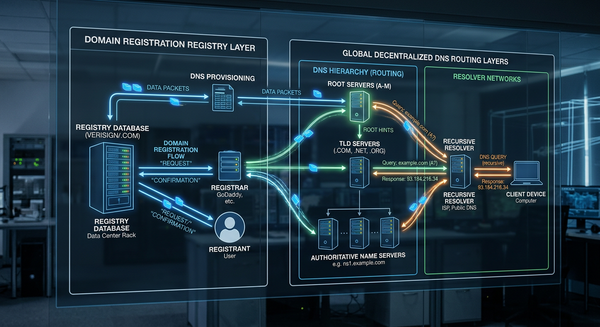
At its core, a domain registration lookup is an interrogation of the database maintained by the registry responsible for the specific Top-Level Domain (TLD). When you look up domain registration details, you are essentially pulling data that the sponsoring registrar has submitted to the registry. This data structure historically followed the WHOIS protocol, a text-based query system, but has evolved into the more robust Registration Data Access Protocol (RDAP), which provides standardized JSON output for better interoperability across the industry ecosystem.
For investors and strategic partners, these lookups serve as an initial filter in the asset acquisition process. By examining the registration date, expiration date, and the registrar of record, one can ascertain the maturity of a domain asset. A domain with a long history of continuous registration often carries different valuation markers compared to a recently registered, speculative asset. Understanding these mechanics prevents amateur mistakes during the due diligence phase of namespace acquisition.
How to Find Domain Registration Information Step-by-Step
To effectively find domain registration data, you should follow a systematic approach that accounts for the complexity of global domain management. Accuracy is paramount, especially when investigating high-value assets.
- Identify the authoritative source: Use a reliable, ICANN-accredited lookup tool or the direct registry website for the TLD in question.
- Execute the query: Enter the full domain name into the search bar. Ensure you are targeting the exact TLD, as variations (e.g., .com vs .net) are entirely different assets.
- Analyze the output: Focus on the 'Registrar' (the company managing the domain) and the 'Status' codes. Status codes like 'clientTransferProhibited' or 'serverHold' provide immediate insight into whether a domain is locked or suspended.
- Evaluate Privacy Redactions: Note if the registrant information is redacted. In the modern era of GDPR and strict privacy regulations, much of the personal information is obscured. Look for a contact email or web form provided by the registrar if you need to reach the owner for commercial purposes.
- Verify the Expiration Date: If an asset is nearing its expiration date, it may be subject to pending deletion or renewal cycles. Tracking this is vital for professional domain management.
Pro Tip: If a standard public lookup returns a privacy-redacted result, look at the 'Name Server' field. Identifying the host or the DNS provider can sometimes reveal the identity of the user if they are using managed hosting services or specific corporate infrastructure.
Understanding WHOIS and RDAP Protocols
The transition from traditional WHOIS to RDAP represents a significant upgrade in how the domain industry handles registration information. WHOIS was essentially a free-text protocol, which often led to inconsistencies in how data was presented across different registrars. This made automated analysis of registration data difficult for large-scale portfolio monitoring.
RDAP, by contrast, is a RESTful protocol that uses HTTP to deliver data in a structured format. It supports internationalized domain names (IDNs) more effectively and allows for more nuanced access control. When performing a search, modern tools often default to RDAP where available. Recognizing the difference helps you extract more meaningful metadata, such as the specific legal jurisdiction of the registrar or the current DNSSEC status of the zone.
Common Pitfalls and Troubleshooting
One common error during a lookup is relying on 'shadow' databases rather than real-time registry data. Many third-party sites maintain cached versions of domain information, which may be months old. Always verify against the official registry portal if the registration status seems ambiguous or contradictory to the website's live state.
Another pitfall is the misinterpretation of status codes. A domain might be 'pending delete' but still resolve to a landing page, leading to the false assumption that it is fully operational and healthy. Furthermore, users often ignore the 'Name Server' information, which is often more indicative of an owner's intent than the redacted registrant contact details. Always check the MX records or DNS configurations if you are investigating the professional use of a domain.
FAQ
Can I always see the owner's name through a registration lookup?
No. Due to privacy protection services and global data protection regulations like GDPR, personal registrant information is frequently redacted or replaced with generic contact aliases managed by the registrar.
Is it possible to lookup domain registration details for all TLDs?
Generally, yes, but the method might differ. While most generic TLDs (gTLDs) follow standardized ICANN protocols, some country-code TLDs (ccTLDs) maintain their own unique registry databases with specific query rules.
Why does my lookup show a different registrar than the website owner's hosting provider?
The registrar is the entity that manages the domain registration and annual fees, whereas a hosting provider is a service that hosts the website files. They are often separate entities.
What does 'clientTransferProhibited' mean in a lookup?
It indicates that the domain is locked at the registrar level to prevent unauthorized transfers. It is a security feature, not an error message.