The window is closed. We are inside it.
ICANN's application window closed on 12 August with more than 1,600 primary applications. TLD Empire filed. Here is what ICANN announced, what we are not disclosing before Reveal Day, and the timeline from here.
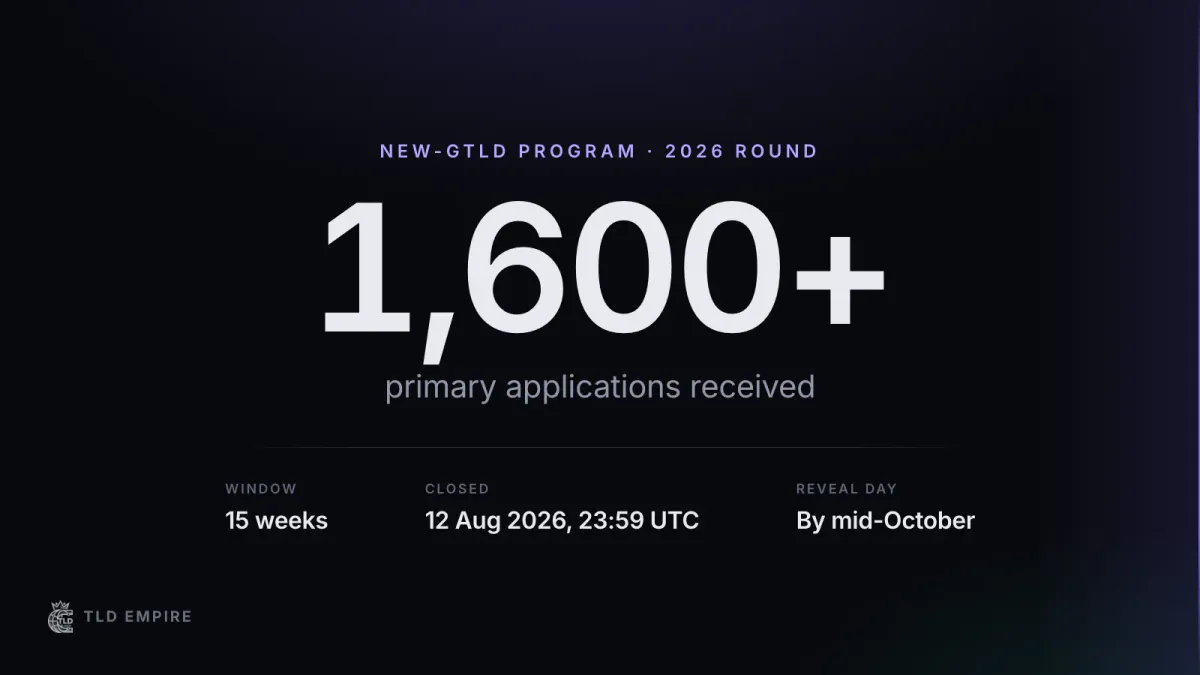
ICANN's application window for the 2026 new-gTLD round closed on 12 August at 23:59 UTC. TLD Empire filed.
That is the short version, and it is the version that matters. What follows is the detail: what ICANN actually announced, what we are and are not saying about our own applications, and what the next nine weeks look like.
What ICANN announced
On 13 August, ICANN confirmed that the 15-week submission period had closed with more than 1,600 primary applications, of which more than 1,100 also included applications for replacement strings. Most of them arrived in the final days of the window.
That total is provisional. ICANN cannot confirm a final number until evaluation fees are received, and the deadline for payment is the later of 23:59 UTC on 19 August or seven days after an applicant's invoice was issued. Expect the headline figure to move slightly.
For context, the 2012 round drew 1,930 applications, and it was the only round of its kind for the following fourteen years. Whatever the final 2026 count settles at, the set of organisations that can own a new namespace this decade is now closed. There is no late entry.
Where TLD Empire stands
We submitted multiple applications before the window closed.
We are not publishing how many, and we are not naming the strings. Not now, and not before ICANN's Reveal Day. That is a deliberate position rather than a coy one.
Applications become public on Reveal Day whether or not the applicant announces them first. Announcing early buys no advantage and gives up two real things. It tells anyone still deciding where to aim their objections, and in a round where contested strings are settled at auction, it hands other bidders a longer runway to prepare for ours. The strings will be public soon enough, on ICANN's schedule rather than ours.
What we will say is what the position rests on. More than $5M was invested ahead of the round. The operating stack was built before the applications were filed, not promised on the strength of them: registry services, a proprietary registrar, and distribution to 11 million real users across our existing properties. That sequencing is the entire thesis. The hard part of a new TLD is not winning the string, it is having somewhere to sell it on day one.
What happens next
- By 19 August: evaluation fees due, after which ICANN can confirm the final application count.
- Mid-September: ICANN announces the date of Reveal Day and the timeline for the milestones after it.
- By mid-October: Reveal Day itself. ICANN expects to publish every application that clears its administrative check no later than nine weeks after the window closed. This is when the applied-for strings, and the contention sets, become public.
- After Reveal Day: three tracks run in parallel. Community input, including public comment and formal objections; contention set resolution, where competing applications for the same string are settled; and evaluation of both the applicant and the application against the Applicant Guidebook criteria.
One change from 2012 is worth flagging, because it reshapes the economics of a contested string: ICANN has prohibited private resolution of contention sets in this round. In 2012, applicants who wanted the same string could and frequently did settle it among themselves, with the losers paid off. This time contested strings go to an ICANN auction. That makes balance-sheet depth and operating readiness matter more than dealmaking, and it is one of the reasons we funded operations before we funded applications.
The window, not the string
It is easy to read a round like this as a race for individual names. It is better read as a fourteen-year door that has just shut. Everyone who is going to operate a new top-level domain before the 2030s is now, definitionally, on ICANN's list. Everything from here is execution: clearing evaluation, resolving contention, and getting a registry to market with real distribution behind it.
We will post again when Reveal Day is dated.