Top Domain Registration Services for 2026: Choosing the Right Provider

Selecting among various domain registration services is a foundational step for any digital asset strategy, whether you are managing a portfolio of premium namespaces or securing a primary gateway for a business. The process of acquiring and managing a digital identity requires more than just an interface; it demands a robust backend that integrates with global infrastructure. When you evaluate where to park your assets, the criteria must extend beyond simple pricing to include security, transferability, and the technical support required to maintain a seamless domain industry investment lifecycle.
Quick Summary
Domain registration services provide the necessary infrastructure to purchase, manage, and renew internet namespaces through accredited registrars. Choosing a provider involves balancing cost, security features, and administrative usability to ensure long-term asset control. Effective management requires providers that offer transparent WHOIS protection and reliable technical support for registry interactions.
- Low cost is a priority, but security and transfer ease are equally critical.
- Proper WHOIS management is vital for data privacy and security.
- Scalability is essential for investors managing multiple digital assets.
Table of Contents
- Comparison of Domain Registration Categories
- Bulk-Scale Institutional Registrars
- Retail-Focused User-Friendly Registrars
- Privacy-Centric Boutique Providers
- Integrated Ecosystem Platforms
- Buying Guide: How to Choose a Provider
- Frequently Asked Questions
- Recommended Reads

Comparison of Domain Registration Categories
| Category | Primary Focus | Best For | Potential Drawbacks |
|---|---|---|---|
| Bulk-Scale Registrars | High-volume management | Domain investors, agencies | Minimal user support |
| Retail Registrars | Ease of use, bundling | Small businesses, individuals | Upsell-heavy interfaces |
| Boutique Providers | Specialized security | High-value, premium assets | Higher price points |
| Ecosystem Platforms | Integrated distribution | New-gTLD portfolios | Specific platform lock-in |
Bulk-Scale Institutional Registrars
These providers are engineered for users who need to manage hundreds or thousands of domains simultaneously. They prioritize API access, bulk renewal tools, and sub-account management, which are essential for those building a significant namespace acquisition strategy. The interfaces are often utilitarian, stripping away the marketing noise found on retail sites to focus strictly on functionality and speed.
- Pros: Robust API capabilities, aggressive volume-based pricing, and clear, uncluttered management consoles.
- Cons: Steeper learning curve for beginners and limited "concierge" style customer service.
Retail-Focused User-Friendly Registrars
Retail registrars emphasize a frictionless experience for the average user. They often bundle domain registration with website builders, email hosting, and SSL certificates. While these services make it easy to find domain registration options, users must be cautious of "teaser" pricing that increases significantly during renewal cycles.
- Pros: Highly intuitive interfaces, integrated suite of auxiliary services, and excellent documentation for non-technical users.
- Cons: High likelihood of aggressive upselling and potential complexity when attempting to transfer domains out of the ecosystem.
Privacy-Centric Boutique Providers
For investors who prioritize the "who is" data privacy of their holdings, boutique providers offer specialized protection layers that go beyond standard contact redaction. These services often cater to high-net-worth individuals and organizations that require extra caution regarding the public disclosure of ownership information.
- Pros: Advanced security protocols, personalized account management, and superior data masking techniques.
- Cons: Generally higher registration and renewal fees compared to mass-market providers.
Integrated Ecosystem Platforms
These platforms represent a shift in the industry, where registration is part of a larger distribution network. They are designed to drive traffic to newly launched namespaces immediately. For investors focused on the ICANN 2026 round, these providers demonstrate how a registry can create value by having a pre-built user base ready to adopt new TLDs.
- Pros: Instant distribution potential for new namespaces and deep integration with marketing tools.
- Cons: Focus is often specific to the provider's ecosystem, which may limit general-purpose utility for legacy domains.
Buying Guide: How to Choose a Provider
When evaluating domain registration services, start by determining your core objective: volume, security, or simplicity. For those seeking domain name registration low cost, always verify the renewal price, as introductory rates are rarely representative of the long-term cost. Furthermore, examine the provider's ICANN accreditation status. A direct relationship with a registry-accredited registrar reduces the number of intermediaries, which can speed up administrative processes and increase security.
Technical proficiency should also be a deciding factor. If your operations require automated updates to DNS records or bulk management of ownership information, ensure the provider offers a stable, well-documented API. Lastly, audit the "domain name registration who is" settings. Ensure that the provider allows for comprehensive privacy options that comply with modern data protection regulations without sacrificing your legal control over the asset.
Frequently Asked Questions
What is the difference between a registrar and a registry?
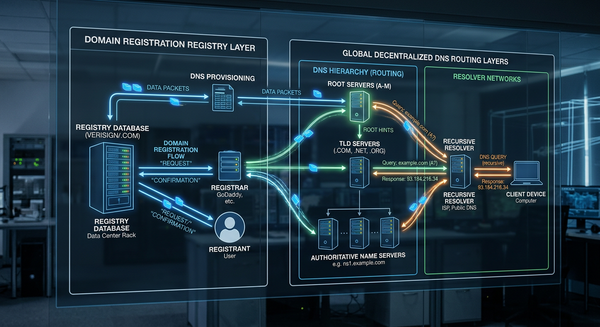
A registrar is the company you pay to manage your domain, while the registry is the organization responsible for managing the actual database of all domains within a specific top-level domain (TLD), such as .com or .net.
Are "free" domain registration services actually free?
Usually, these services are bundled with a paid hosting or website builder contract. It is rarely truly free, and the total cost of ownership often exceeds that of buying a domain separately from a dedicated registrar.
How does WHOIS privacy protect my information?
WHOIS privacy replaces your personal contact details (name, email, phone) in the public database with generic information provided by the registrar, preventing spam and identity scraping.