Understanding the Global COM Domain Registry and Regional Alternatives in 2026

Selecting the appropriate namespace architecture is a foundational decision for any entity involved in digital asset management. Whether navigating the complexities of the com domain registry or evaluating the regional oversight of a country-code top-level domain, investors must understand the varying operational models, policy frameworks, and market dynamics that govern internet infrastructure. As the industry evolves, the distinction between open commercial registries and strictly regulated sovereign namespaces becomes increasingly critical for long-term strategic planning.
Quick Summary
Global domain registries function as the authoritative databases for top-level domains, managing registration data, zones, and DNS resolution policies. While the com domain registry serves as the primary commercial backbone of the internet, regional alternatives offer distinct legal protections, eligibility requirements, and local market trust advantages.
- Registries serve as the central source of truth for domain ownership.
- Policy frameworks vary significantly between generic extensions and country-specific codes.
- Operational stability and registration requirements are core investment considerations.
- Navigating these namespaces requires understanding both technical and regulatory infrastructure.
Table of Contents
- Global Domain Registry Comparison Table
- The COM Domain Registry and Infrastructure
- Regional Options: Domain Registry EU and UK
- Specialized Extensions: LK Domain Registry and ORG Registry
- Buying Guide: Evaluating Registry Reliability
- FAQ
- Recommended Reads

Global Domain Registry Comparison Table
| Registry Type | Primary Use Case | Key Constraint | Market Reach |
|---|---|---|---|
| COM Registry | Global Commercial | High Competition | Worldwide |
| EU Registry | European Union | EU Residency Required | European Market |
| UK Registry | United Kingdom | Stringent Policy | UK-Focused |
| LK Registry | Sri Lanka | Local Presence | Regional South Asia |
| ORG Registry | Non-Profit/Entity | Institutional focus | Global/Institutional |
The COM Domain Registry and Infrastructure
The com domain registry remains the most significant component of the internet's naming ecosystem, acting as the primary digital address space for global commerce. Its operation is defined by massive scale, high liquidity, and a relatively open registration policy that permits nearly any entity to secure a footprint. For investors examining TLD Empire methodologies, the com namespace is often the benchmark for secondary market valuations and asset turnover velocity.
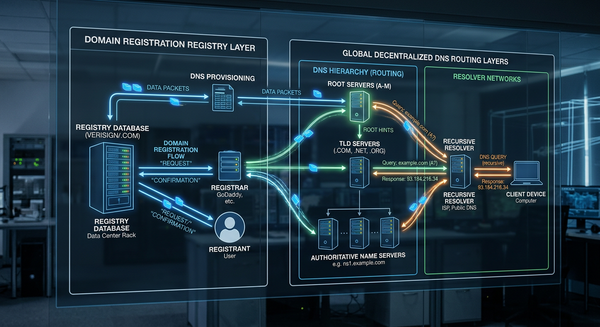
Operationally, the registry acts as a centralized database of all domain names registered within its zone. It interfaces with registrars through the Extensible Provisioning Protocol (EPP), ensuring that registration, renewal, and deletion requests are processed in real-time. Because of its ubiquity, this namespace faces the highest level of contention, leading to premium pricing for high-value dictionary terms and short, brandable sequences.
Regional Options: Domain Registry EU and UK
Regional registries like the domain registry eu and domain registry uk operate under localized governance models that prioritize trust and jurisdictional compliance. Unlike the open-access model of generic namespaces, these registries often enforce residency or nexus requirements to ensure the domain owner is connected to the region of the extension.
These namespaces provide high levels of consumer confidence because users associate them with specific legal protections and local data privacy standards. For businesses or investors, these registries offer a way to signal presence in a specific market. However, this comes with the trade-off of stricter policy enforcement; non-compliance with regional residency rules can often lead to the rapid suspension or revocation of the domain assets, necessitating careful due diligence during the acquisition phase.
Specialized Extensions: LK Domain Registry and ORG Registry
Beyond commercial and regional namespaces, specialized registries such as the lk domain registry and the org registry serve niche requirements. The org registry, historically reserved for non-commercial entities, maintains a distinct user base that prioritizes institutional credibility over purely commercial gain. Understanding the specific investment thesis behind these extensions is essential for those looking to diversify their portfolio beyond the standard commercial offerings.
Meanwhile, the lk domain registry offers a look into sovereign infrastructure, where local adoption rates and government-backed policies dictate the growth curve. These registries often operate with lower volumes than the global giants but can provide significant value in emerging markets where the internet economy is still maturing. Investors must be aware of the localized support systems, as downtime or administrative friction in these smaller, more centralized registry environments can directly impact the accessibility of the assets managed within them.
Buying Guide: Evaluating Registry Reliability
When evaluating any registry, whether it is a global net domain registry or a localized extension, professional operators look for technical robustness and clear policy frameworks. A reliable registry ensures high uptime for its DNS services, as even a minor outage can lead to significant revenue loss for businesses relying on those assets. The technical stack, particularly the implementation of DNSSEC, is a critical indicator of the registry's commitment to security.
Furthermore, the legal framework surrounding the registry dictates the risk profile of the investment. Review the dispute resolution policies, such as the Uniform Domain-Name Dispute-Resolution Policy (UDRP), which standardizes how contested names are handled. A registry that is transparent about its administrative processes and its relationship with ICANN policies is far more likely to provide a stable, long-term return on investment than one with opaque rules or unstable ownership.
FAQ
- How does a registry differ from a registrar? A registry is the central database and authoritative operator for a specific top-level domain, while a registrar is the retail company that sells domain names to the end user.
- Why is residency required for some regional registries? Residency requirements ensure that the domain space remains relevant to the local market and complies with regional consumer protection laws.
- What is the importance of the registry’s technical stack? The technical stack manages DNS resolution and zone file updates. Reliable infrastructure ensures that domains remain accessible globally without resolution errors.